New SEO Process

Welcome To Our Blog

New SEO Process

Welcome To Our Blog

New SEO Process

Welcome To Our Blog

New SEO Process

Welcome To Our Blog

New SEO Process

Welcome To Our Blog

6 Common SEO Mistakes to Avoid

06:23 |

6 Common SEO Mistakes to Avoid and How to Fix Them Read more at http://www.jeffbullas.com/?p=31249#EfvydZ8bw8QS1OJD.99

After years in SEO, I’ve seen thousands of websites and audited hundreds of them. After a while, one starts to notice trends. The same basic SEO errors are repeated over and over. Most of these are easy to find and fix, the kinds of things that any decent SEO consultant should be aware of.

If you have a site and don’t have an SEO consultant, these are a few of the things you can quickly go and check yourself. If you do have an SEO consultant, they should have brought these issues to your attention.

If they haven’t …and sadly I see a lot of clients who have had “SEO consultants” for years but still have these problems, you may want to question if you have the right consultant working for you.

Here are 6 common SEO mistakes to avoid

1. Duplicate content

What is duplicate content? Duplicate content in the context of SEO, means the same content appearing in more than one webpage (URL) within same or different domain (web site). The most common problem with duplicate content is that search engines can’t decide which content to index, eventually not showing this web page in search results.

Duplicate content can come under different types. One of the most common errors is duplicate versions of the homepage:

Homepage Duplication

One of the first things I check with a site is whether there are duplicate versions of the home page.
Here are some examples of duplicate homepage:
  • http://www.example.com.au
  • http://example.com.au
  • http://www.example.com.au/index.html
  • http://example.com.au/home
  • http://example.com/default.aspx 
If you are serving duplicate versions of your home page to the engines, they are duplicate content. The engines will usually figure out which version to index, but sometimes they get it wrong. So why confuse them if you don’t have to?

Duplicate URL

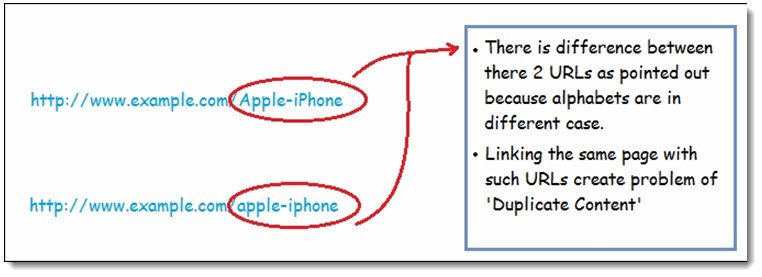
I have seen quite a few duplicate URL’s, where upper case or lower case URL text are used inconsistently, causing search bots to be confused and consequently devaluing the URL  or not ranking your website highly.

The issue here is if you have all your internal or external links pointing at www.example.com/Apple-Iphone  or www.example.com/apple-iphone  and the “real” version of the page is www.example.com/apple-iphone, you’re splitting the link equity between these two URLs. You want all that linky goodness pointed at the one original URL you want to rank in the search engines.
6 Common SEO Mistakes

Different Webpages Having Nearly Similar Content

Almost every site I’ve ever worked on or for has had duplicate page content problems.
Duplicate content happens when you or your staff either copy some other website content then paste it on your site or you use same piece of content across different pages within your website. This issue occurs more often especially when an SEO guideline has not been put in place in the architecture phase of building a site. A designer or content writer for your website might not pay attention to it because they are not SEO specialists.

How do you resolve these duplication issues?

  • Minimise similar content: If you have many pages that are similar, consider expanding each page or consolidating the pages into one. For instance, if you have a restaurant site with separate pages for two locations, but the same information on both pages, you could either merge the pages into one page about both locations.  You could also separate it into two pages and write unique content about each location.
  • Delete duplicate page version of your content
  • 301 redirect the duplicate versions to the original ones or Place “rel canonical” tag on the original page  to send a strong hint to search engines your about preferred version to index among duplicate pages on the web. If you are not clear what 301 redirect or rel canonical tag are, just ask your web developer to fix them for you.
6 Common SEO Mistakes

  • URL best practices: Use hyphens to separate words when necessary for readability. They should not use underscores, spaces, or any other characters to separate words. The URL of a web document should ideally be as descriptive and brief as possible. Do not use CAPITALS in words in URLs.

2. Forgotten about content marketing

Don’t expect that your hired SEO team will make your website traffic take off significantly just with onsite optimisation, link building and without any content strategy in place.

Many things in the SEO world have changed drastically, especially for the last couple of years when content has started to play a critical role in determining whether your SEO or digital marketing campaign is successful or not. Any SEO strategy without content marketing in place should not be considered. The days that SEO agencies build hundreds of backlinks on directories, social book marketing sites, blog comments and forum comments pointing to a static website are well and truly over.

Let me give you an example:
When I started working on New Cars Plus (which are a discount new cars buying services based in Sydney). Their website was as static and had very low traffic. It had only 400 visits a month. After 12 months of regularly creating and posting content, the site traffic soared from 400 visits a month to 8,596 visits per month.

6 Common SEO Mistakes
Wow!!…. Did I do that? The good news is that it wasn’t rocket science but a combination of link building, pure content production and social seeding.

So my point is not to expect your website traffic to be soaring up the rankings with pure off-page optimisation (link building and social signals). Remember, this site took 12 months of continuous work.
Even if you rank number one on a number of keywords (in the case of a perfect world), the maximum traffic you’d get is xxx number of visits per day and it is not growing, especially with the constant updates from Google, your high ranking positions are not ensured.

3. Poor site structure

Often when building a new website, your web developer doesn’t integrate best SEO practices into the website structure. This is totally understandable because the web developer is not an SEO specialist. Therefore an overlooked facet of site architecture (in other words, the way the website is laid out and how the pages connect to each other) is fairly common.

I would argue it’s the single most underrated area of SEO.

In general, the home page of your site is going to have the most authority because it’s going to have the most incoming links and the best quality of inbound links. Authority (or link juice) flows throughout a website from high authority pages to low authority pages through links. For every step away a web page is from the home page, the less and less of that total authority is going to be passed to it. All other factors being equal, the further away the page is from the home page, the worse it will rank.

I’ve seen cases of high authority web pages being buried deep in site architecture and losing rankings dramatically. I’ve also seen the reverse where web pages are moved closer to the home page and suddenly jump several spots in Google. Ultimately you want to create your website structure so it is easy and intuitive to navigate for users.

A flat structure often satisfies that requirement and will help you get more of those users to your site through search engines.

6 Common SEO Mistakes

Here is another example of mine, this website at www.warrantyandinsurance.com.au  and extended car warranty insurance company.

We  built a flat architecture site, having all related pages linking to each other through targeted keywords, writing unique Meta Title and Meta Description, page content with targeted keywords.

This is basic on-page optimisation stuff which also includes updating the site twice per month with some blog posts (I should produce more content than that, but it is a low budget site).

Despite that the website traffic has been naturally growing at the rate of 30% month on month and generating more than a 8.5% conversion rate. Compared to other car insurance sites this is a huge success considering I haven’t done any link building to this website.

4. Don’t have a mobile site design for multiple screens

Google is now taking into consideration the mobile when ranking websites. Here are some other facts to keep in mind about the importance of a mobile site

  • 61% of customers who visit a mobile unfriendly site are likely to jump to a competitor’s website (Karim Temsamani at IABALM 2012 via IAB)
  • According to a recent Herald Sun report, smartphone users in Australia will reach 12.2 million in 2013.


  • Traffic coming from mobile devices from websites I have managed is now at an average of 25% and it is still going upwards.


With so much focus on usability, the demise of the desktop browser dominance, and the prevalence of mobile devices, Google’s made it very clear that no mobile experience, no love from Google!

Therefore, creating a user-friendly site design that works well and fast across all devices…especially mobile and tablet.

Mobile versions for your website can be built easily by using one of three popular mobile design technologies such as dedicated mobile site( m.example.com.au) or responsive design (Google’s preferred method) or native application (for complex design/user interface).

For most of the simple sites, I would recommend using responsive design for anyone who has limited resources for maintenance, limited budget and want a SEO-friendly website. I built this Responsive Design Testing Tool on my website. So if anyone of you wants to see how your website looks like on different devices, check out this tool.

6 Common SEO Mistakes
                             

5. Unreasonable SEO expectations

SEO isn’t easy, fast, or cheap. Gone are the days of scalable, easy tactics that exploited loopholes in the algorithms.

Another thing, there is a widely-held belief that SEO is all about rankings on a certain keywords. I don’t totally agree with this, let me show you why.

Most of the time customers want to target short-tail, competitive and high search volume keywords such as:
  • Truck finance
  • Equipment loans
  • Machinery finance
The reality is much different. People type in search terms differently and most of them use long-tail keywords. Some examples of this are:

  • “Truck finance no deposit”
  • “Bad credit truck financing”
  • “How can I get equipment finance with bad credit”
  • “Machinery finance no credit check”
And guess what?
They are not on your keyword ranking list. Another thing according to the latest research done by Neil Patel, is that long-tail keywords generate more conversion than short-tail ones.

6 Common SEO Mistakes

If you look at the image above, you’ll notice that one- or two-word key phrases are costly to rank for and they don’t convert well. Searchers are also getting more sophisticated and are starting to use more words in their searches.

Many websites have high traffic coming in but it doesn’t convert well as people bounce in and out. Does your ranking help in this case? Not really.

My point is the SEO success measurement should not solely or mainly based on ranking; other factors such as traffic, longer time visit, lower bounce rate, and most importantly more enquiries or sales are things to look at.

Thirdly, if you want to have a successful SEO campaign, your website have to deserve it. Many site owners think that SEO can make up for the fact that the site is not exceptional, but that’s just not the case.

Take a good hard look at your site and your business. If you truly deserve to SEO success, SEO can help you get there. But if your user interface sucks, your design is dated, your prices are too high, your content is self-centered and boring or your customer service is lousy, fix that stuff first. Then do SEO stuff to get you where you should be.

In the old days you could be successful at SEO and generate the money to make your site great. Now you have to spend the time and money and resources to be great, and then you can be successful at SEO.

6. Hiring a crappy SEO consultant

I hate to say it, but this is still one of the most common SEO mistakes I see business owners making.
Whether it’s because you don’t want to (or can’t) allocate the resources or because your SEO agency/consultant is lazy, incompetent, out-of-date, or just taking you for a ride, hiring an SEO that isn’t on his or her game is the most dangerous SEO mistake of all.

Hiring a crappy SEO used to be just a waste of money at worst, but now they can bury you. I’m not talking black-hat stuff here either. Even in my short time as a full-time consultant (after many years in-house) I’ve talked to site owners who have SEO consultant who:

  • Missed most of the items above
  • Built large numbers of crappy, money keyword anchor text focused links from spammy blog networks and directories (Ever heard of Penguin?)
  • Claim to have built links that they couldn’t show the client because it would give away their “secrets”.  If any SEO agency you talk to seems vague and indirect in their answers, doesn’t want to show you the link report of existing clients (assuming they are allowed to), move on to the next agency.
During my time as a SEO consultant, I have had to fix many bad SEO sites. You are better off not having an SEO consultant at all than having a bad SEO site.

Conclusions

I’ve pointed our most common mistakes that people have when it comes to SEO, there are many SEO mistakes that you should look out too, but I think you should leave them to your SEO specialists, as the owner of the website or marketing manager, you should look at SEO from high-level, strategic point of view to make sure that your SEO campaign is heading to the right direction.

My recommended SEO approach here is to fully optimise your onsite for search engines, optimise your landing pages for better conversion, develop awesome content and generate high quality, thematic links to your site. Does it sum up everything about SEO? Pretty much I believe.


I will cover some cool SEO topics later on, stay tuned!! If you have any questions or comments, feel free to leave some below.


Read More

Google celebrates 15th birthday : 15 things you didn't know

22:33 |

September marks 15 years since graduates Larry Page and Sergey Brin set up a small web crawler from a garage in Silicon Valley, which went onto become the world's biggest search engine.

The site was originally called BackRub, but was changed in 1997 to Google - a misspelling of the word googol which is a term for the number one followed by one hundred zeros.

There is a little confusion around when Google's official birthday is, but reports claim papers to incorporate the company were filed on September 4 1998. The company became incorporated three days later and the domain was registered on September 15.


A screenshot from the beta version of Google: September marks the 15th anniversary of when Google was first incorporated by founders Larry Page and Sergey Brin. The company started from a garage in Silicon Valley in 1998 and is now the world's largest search engine -with more than 13 billion searches a month.

Google's 15th birthday: 15 things you didn't know

From the company's original name to the first Google doodle, we search the archives of Larry Page and Sergey Brin's tech giant for some little-known titbits.


Google is 15 years old today. To celebrate, here are 15 facts you probably didn't know about them.

1. Google was originally called BackRub. The homepage read: "BackRub is a 'web crawler' which is designed to traverse the web."

2. Google has acquired an average of one company every week since 2010.

3. The first Google doodle was a Burning Man symbol. Founders Larry Page and Sergey Brin went to the Burning Man festival in 1998 and added the doodle to let users know they were away from the office that weekend.

4. Google hired its first in-house chef, Charlie Ayers, in November 1999, when the company had just 40 employees.

5. Ayers went on to become the firm's executive chef, overseeing a team of 150 employees across 10 cafes at its headquarters in Mountain View, California.

6. You can use Gmail in more than 50 languages. These include: Welsh, Basque, Tagalog, Malayalam, Telugu and Cherokee.The first Google Doodle from 1998 – incorporating the Burning Man logo. Photograph: Google


7. Around 1,000 of Google's employees became millionaires when the company went public in 2004.

8. One of those millionaires was masseuse Bonnie Brown, who worked at the company giving back rubs for $450 a week back in 1999.

9. The "I'm Feeling Lucky" button, which bypasses the results page to take users directly to the first result of their search, has been estimated to cost Google around $100m in lost ad revenue every year.

10. Google hires goats. In 2009, the company rented around 200 goats for a week to eat the grass and fertilise the soil at its California headquarters.

11. Google's first official tweet was the words "I'm feeling lucky" in binary.

12. Almost all of rival company Mozilla's money comes from Google. The firm pays $300m a year to be the default search engine on Mozilla's web browser Firefox.

13. Google founders Larry Page and Sergey Brin own just 16% of the company.

14. That 16% gives them a combined net worth of around $46bn.

15. A new Google employee is known as a "Noogler" and a former employee is referred to as a "Xoogler".
Read More

Happy Birthday Penguin!!!

22:12 |

Happy Birthday Google's Penguin Update

penguin birthday
Today is the one year birthday/anniversary of the release of Google's Penguin update - it was released on April 24, 2012. Since then, we've had two additional updates of it on May 24, 2012 and then on October 5, 2012. Now we await the fourth update which is expected to be really big sometime this year.

This update was felt by more SEOs than the Panda update. In fact, our polls (very scientific ones) said 65% of SEOs were impacted by the update. And our polls also show that 94% didn't fully recover from the Penguin update. So this update is serious business for SEOs, webmasters, businesses and of course, Google.


Happy Birthday Penguin! You're one year old. By now you should be able to walk, talk and understand the difference between good and bad. The last one probably still needs some improvements but anyways, here's your birthday song: 


Now, I know joking about this update is insulting to many SEOs and webmasters. But sometimes, we need a smile. I hope anyone impacted by Penguin or any Google update finds their way back to making a lot of money via Google.
Read More

SEO Preparation for 2013: Build Up Your Author Rank

22:49 |


The first week in December marks the need to get ready for the New Year. Whether your business slows down or speeds up during the holidays, the New Year is coming and people are expecting bigger and better things from their favorite businesses. If the consumers weren’t enough to get you thinking about 2013, think about your competition. Most companies will look back at the last year, analyze their mistakes and their successes, and create an improved strategy. It’s important your company do the same.

One of the things that will be important this upcoming year will be author rank. For those who are unfamiliar, author rank is a way for Google to rank the quality of particular authors. This only helps increase relevancy for users, so it’s quite clear that Google will put a larger emphasis on Author Rank in 2013. So how to begin to build an Author Rank? It’s easy, and you may already have started without even realizing it.
How to Begin Building an Author Rank
Building an Author Rank doesn't have to be difficult, but it is a task that takes time and is something you have to understand before you can really get going. Below are a few different ways you can begin to build your author rank:
  • Google Authorship Markup. This is probably the most important thing an author can do to help gain a good ranking and gain more exposure. Authorship markup is a way for you to connect you writing with your Google+ profile. All you need to do is: Set your Google+ posts to public à Go to “Contributor To” under the “About” section of your profile à link your sites by adding them to this section, and you’re finished! Eventually the results for your content will look like this on a Google SERP:
     
  • Google+ Sharing. Google is going to take into account how active you are on Google+ because this helps improve the popularity of your content. This means that you should always share all of your content and include every site you contribute to in your “contributor to” section. I myself have been slacking in this department, but 2013 is certainly the year to make it happen. Also make sure that you’re actively looking to connect with those in your industry and using Google ripples to get your content shared.
     
  • Google+ Connection. If Google understands your connections it will help them improve the relevancy of your Google results. This makes it incredibly important that you’re not only adding people to your circles, but that others are doing the same to you.  The New Year will be all about connections and what you decided was relevant to you, so getting started now is vital!
     
  • Google+ Activity. Not only do you want to share your own content, but you will want to share the content of others. Make sure you’re always out +1ing content you like and commenting on your connections. This will show Google that you’re actually social and helping your connections.
     
  • Other Networks. Although Author Rank relies heavily (very heavily) on Google+, having a presence on other social networks is still important. Your Author Rank should encompass everything about the author and all of his/her interactions, and Facebook and Twitter are a part of that.
     
  • Great Content. Although obvious, it never hurts to mention the importance of great content. If you want a good Author Rank, you’re going to need people helping you, and that simply won’t happen if you’re not creating meaningful content for your readers.
If you own a website or a company website and you’re not the primary writer, it is still important the those who do write content on your website begin to build up his/her author rank. This is great for the author, but it also helps this content to show up at the top of a Google search. It’s essentially a win-win.

Inspired Article From: http://www.highervisibility.com/blog/seo-preparation-for-2013-build-up-your-author-rank/
Read More

How to remove Face book Fake likes?

13:00 |


Been buying Facebook Likes to make your page seem, well, more likable? Know a site that has? Facebook doesn’t like that, and now it’s taking steps to remove those it deems fake.
Writing today on the Facebook blog, the company said the change is likely to impact less than 1% of the Likes for any particular page and will aim to remove Likes such as those generated by malware, “deceived” users or purchases.
From the post:

We have recently increased our automated efforts to remove Likes on Pages that may have been gained by means that violate our Facebook Terms.
On average, less than 1% of Likes on any given Page will be removed, providing they and their affiliates have been abiding by our terms.
These newly improved automated efforts will remove those Likes gained by malware, compromised accounts, deceived users, or purchased bulk Likes.
Of course, some sites that have depended on fake Likes will likely see much more than 1% of their Likes take a hit.
Read More

Majestic SEO Launches Keyword Checker ( InAnchor InTitle InURL )

22:41 |


Today we are really excited to add a new twist to our offering in the form of a Keyword Checker and bulk Keyword Checker.

From today you can type a keyword into our home page instead of a web URL and start to see how many web pages use the phrase in the Anchor Text or in the title of a URL or a domain. These are commands that were once available in some search engines, but the functionality was taken away. We assume it was deemed to valuable for the general SEO public to have.We have also created a bulk keyword checker tool, designed to let you add hundreds of keywords into a list and see these metrics or export them as a CSV file.

Why is this useful?

You now have the ability to see how competitive key phrases are in ORGANIC search. Until now, SEOs have had to rely largely on Google’s paid search keyword tool bench-marked against its expected cost to rank in Adwords to make assessments as to how competitive a phrase is. However – there is a marked difference between the nature of organic and paid results and how you succeed in search partly depends on knowing how to blend the channels.In its raw form, this is a great new research tool which we hope users will delve into. What is more important to people according to the “Big Data” map that is the web? “airline tickets”, “flight tickets” or “plane flights”? Well now you can find out in a trice.


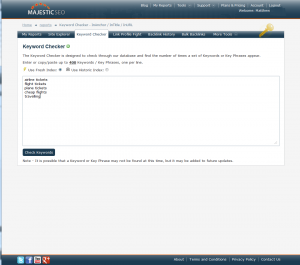
Our bulk keyword checker tool
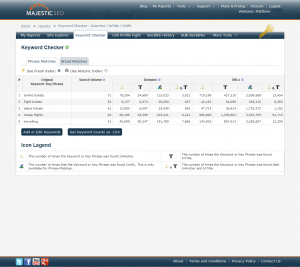
You can always test out the “good stuff” over on the live keyword checker tool, but you can cut and paste hundreds of keywords in at a time. The actual number depends on your subscription level – with silver users (£29/€39/$49/mth) currently getting 150 phrases at a time. The results are currently shown as two sets of counts: Phrase match and Broad match.

                                   
                                       Keywords Checker results are available in a flash

Can I see the ACTUAL domains that use these?

Not right now – but we are constantly developing. Ever since in:url, in:title and in:anchor was stripped from advanced search engine commands, this feature has been unavailable to most users. We are reincarnating the features, but rebirth isn’t instant. We hope you will find value in this new feature and would love to especially see posts about how you might blend this data with PPC data to work out whether to focus on PPC or Organic for any given phrase.

Did we develop anything else while we were at it?

Wow – you guys are DEMANDING. OK – we sussed out how much people searched for most of these phrases and created a “Volume Score” which is a 1-100 scale for each phrase showing how often we believe it is searched for. A high number means a very highly searched phrase. We have embedded these numbers into the reports as well, so that when you analyse the phrases, you can make judgements in balancing search volumes with organic ranking challenges.

Inspired Article From: http://blog.majesticseo.com/development/keyword-checker-inanchor-inurl-intitle/
Read More

Official Google Panda Update Version 3.8 On June 25th

22:18 |


Google has announced they pushed out a new refresh to the Panda algorithm recently.This update “noticeably affects only ~1% of queries worldwide,” said Google on Twitter.
There were earlier rumors of an update over the weekend but Google said the rollout started today and not over the weekend.
The previous Panda update was on June 8th and before that on April 26th. Typically, Google pushes out algorithm updates for Panda and Penguin every month or so. While the last Panda update was just over 2 weeks ago, Google felt they wanted to push out a new refresh.

Heads up: we're pushing a new Panda data refresh that noticeably affects only ~1% of queries worldwide. More context: 
goo.gl/HNvCt
Google said there were no updates to the algorithm or changes in the signals. This was simply a basic data refresh where they ran the algorithm again.
For more on Panda update, see our Panda update category.
Read More

Google Panda for SEO Folks that Aren’t Bears (Infographic)

23:02 |

Over the past year, Google has been using a cuddly toy to wipe out what it sees as spammy content, taking down some pretty big players in the process. It made a lot of people nervous – so I thought I’d share this infographic that does a good job of breaking down it’s history and how you should go about making your site Panda proof…

Read More

How Do Recover A Site From Google Penguin Update | Tips For Recover A Site From Google Penguin Update

06:09 |


Google has recently updated A new Algorithm to dig over out horrific websites from the good quality and many website owners now find that their websites have totally vanished from the search results. The first major update to Google’s algorithm was the Panda update. It was intended to find and remove websites that were perceptibly using spamming tactics to rank high in search results. Now the Penguin update has wreaked disaster for many websites.
Penguin hit EMD (Exact Matching Domain)
This time EMD’s [Exact Match Domain] has got hit i.e. most of the domain containing exact keywords have got penalty. Most probable reason of penalty is link building structures these websites are using. Since this website contains main keyword with their domain name, hence link building is done with same anchor text.
In 2012 Google  has got many algo updates for search engines.
We have seen over optimization or web spam algorithm update later which was named as Penguin. (Later on its update came with name Penguin 1.1).Just before it we have seen various Panda update like Panda update 3.2, Panda update 3.3, Panda update 3.4, Panda update 3.5 & Panda update 3.6)
Private Blog Networks got banned.
Many Low quality Article sites were banned.
Many websites with exact match anchor text got penalized.
We have got Knowledge graph.
Google Places pages were replaced by Google+ Local Pages.
Basic of Google Penguin Algorithm
Penguin is an algorithm (just like Google Panda) introduced by Google to fight spammy websites for better SERPs (Search Engine Result Pages) and user experience. This algorithm basically fight against spammy activities like Keyword stuffing, Cloaking and link SPAM. And, encourages webmasters to follow the Google’s quality guidelines .
Google will continue to update the Penguin algorithm version, every few months, to continue the fight against SPAM.
How to Know – You are Hit by Penguin


The simplest yet proven method is – Open your Google Analytics and  “ monitor your organic visitors from Google ”.
If the number of visitors dropped at least 33% just after an update, then you are most probably hit by the Penguin. You should also consider about Google Dance, before the final decision.
In precision, there are many websites that should have been removed. The websites that were hardest hit are the ones that use spam and other technique to try to get a better search position. Not all sites exaggerated by Penguin engaged in spam. In fact, one of the main reasons to get hit by Google is using bad linking practices. So how can people recover from the latest Google shakeup? Let’s look at some strategies for recovery.
Most websites are not so much guilty of spamming their links to thousands of websites, as they are of indulging in bad linking practices. If you have used link networks, used sponsored WordPress themes, or reciprocal linking that is of poor quality, your website may have been hit by the Penguin update. According to Google’s Matt Cutts, “It is possible to clean things up.” If your site has been hit by Penguin (you will know this because your traffic has dropped since the April 24 Penguin update), there are quite a few things you can do to bring your website back up in the search results.
Tips For Recover A Site From Google Penguin Update
1. Remove any on-page spam on your website. Examples of on-page spam include due to excess of keywords, such as buy or used cars, in order to rank better in search results. Poor quality and spun content that is stuffed with keywords, but offers the visitor no value otherwise, should be removed and replaced with high quality content that is relevant to the website.
2. If you know that you have bad links, clean them up as best you can. Simply enter your website URL into Google search and see what kind of links come up. Examples of links that can be removed include forum profile links. This is, of course, only possible if you have the login information so you can erase the links in the profiles.
3. There is supposed to be a further Penguin update. Website owners are advised to wait until the next update to see if their website recovers. In the meantime, stop all excessive linking practices. It may be a good idea to opt out of link networks for the time being, since these are being hit especially hard.
4. There is also news that some WordPress plugins are inserting hidden links. This may have caused a penalty. Try removing WordPress plugins to see if this makes a difference. If your website does not recover after a few months, it may be necessary to start completely from scratch with a new website. Sometimes it is best to cut your losses and start again.
5. If you feel you are innocent of spamming but have been hit anyway, there is a form that can be filled out on the Google website that allows you to explain your case.
8 Best Recovery Tips 
1. Keyword stuffing: Make a site-wide audit for keyword stuffing. Check for high ranking pages, who have suffered more on SERPs.
How to do: Check for the total number of words on a particular post or page from your Admin Panel. Then, check the number of times a particular keyword repeated on that page by using the simple ‘ find ’ feature in your browser (Edit –> Find or Ctl + F). If the keyword density is more than 2%, simply restructure the article or page with the gist intact. You may consider to update the article with latest info also.
2. Cloaking: If you are practicing any Cloaking or Doorway pages, then stop it immediately.
3. Paid links: If you have purchased any type of backlinks, either from a link farm or from an individual, contact by an Email or telephone and make a request to remove the links as soon as possible.
4. Spammy outbound links: Also known as ‘ Bad Neighborhood ’. If you have given links to any spammy websites, withdraw it immediately.
Check the overall health of the site, to whom you have given the backlinks using 2 simple methods.
(a) Is the site hit by Penguin? (Compete Traffic Stats ) Not so reliable, as Compete updates site status very infrequently and show stats of only US traffic. Still you can use it for assessment.
(b) Search the site for any penalty by Google. Simply type site: Domain name in the Google search. If  no links found or only HOME page is found, then the site is definitely penalized by Google for not following the Google Webmaster Guidelines.
If you think, the site is authoritative and not hit by Penguin, you shouldn’t remove the backlink.
5. Spammy inbound links (-Ve SEO): Check your site-wide backlinks status. Sometimes spammy sites deliberately links good sites with ill intention or with a request from competitor site (paid). This is called -Ve SEO.
But, sometimes your good backlinks turn bad/spammy, because the sites giving links practice black or grey hat seo in the course of time.
Both types of links are unpaid. And, due to the unpaid nature, you have either limited or no control over it/webmasters. You can send Email requests with legal consequences to the concerned webmasters. But don’t expect a quick response or quick result.
Google never penalizes sites for Unpaid-Backlinks with -Ve SEO. In fact, Google excludes the link juice, if any, from spammy unpaid-links during Penguin updates.
So, you shouldn’t worry much about your spammy unpaid-links.
6. Avoid exact anchor text backlinks: Although you have acquired few good exact anchor text backlinks by guest blogging or  paid editorials, Google thinks this is grey hat seo under Penguin updates. Instead of exact anchor text, you should go for long tail or descriptive anchor texts.
7. Avoid directory submission with sole purpose of SEO gain: Google likes paid directory submission, like Yahoo Blog Directory . Because this is paid listing without any guarantee of inclusion of you site, Google thinks it’s transparent and not for the sole purpose of SEO gain/link juice gain.
You may consider listing your blog on few select blog directories like Technorati  for wider exposure only.
8. Unlearn SEO: It’s high time to unlearn SEO a bit to be immuned from Penguin algorithm updates. This is appropriate to newbie bloggers and SEO practitioners who are a bit aggressive while practicing SEO.
Good contents make a great blog, and great blogs make a beautiful web. So, lets make our world-wide-web more beautiful by creating great contents for web-surfers/visitors.
Now the article is open for questions about Google Penguin Updates and various Recovery Tips.

Read More